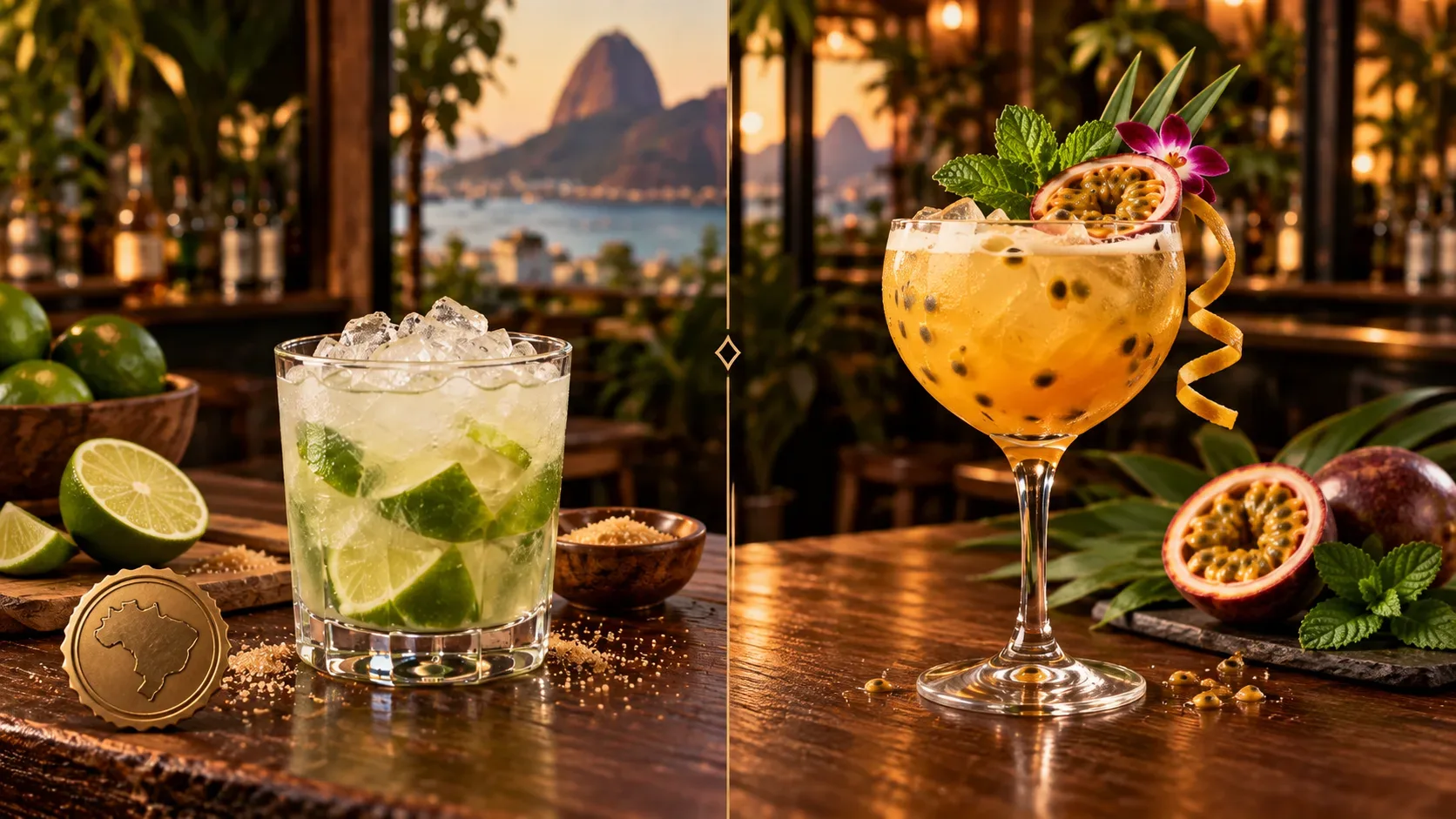
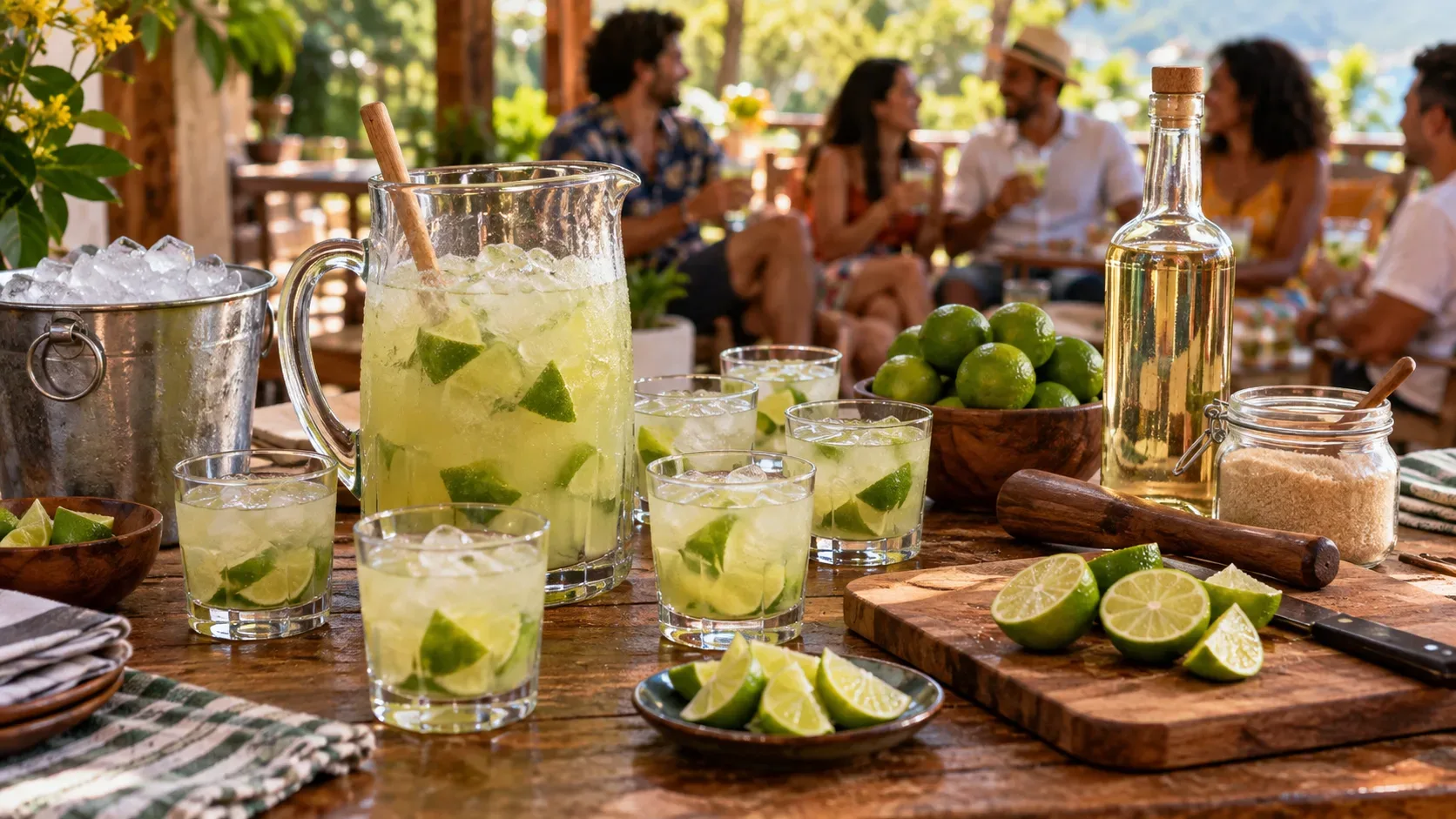
To plan caipirinhas for 20 people without turning the recipe into a confusing multiplication exercise, first separate the number of guests from the number of drinks. The International Bartenders Association (IBA) reference uses, per caipirinha, 60 ml of cachaça, 1 lime cut into wedges and 4 teaspoons of white cane sugar. So one round of 20 caipirinhas requires 1.2 liters of cachaça, 20 limes and 80 teaspoons of sugar.
For shopping, it is useful to allow a small operational buffer: for 20 drinks, have about 1.5 liters of cachaça, 22 to 24 limes and 500 g of sugar. This buffer does not change the recipe; it simply covers differences in lime size and yield, small measuring losses and the fact that bottle sizes rarely add up to exactly 1.2 liters. If you want to serve two caipirinhas per person, double the base and plan for 40 drinks.
Amounts for 1, 10 and 20 caipirinhas
| Quantity | Cachaça | Lime | Sugar |
|---|---|---|---|
| 1 drink | 60 ml | 1 lime | 4 teaspoons (about 18–20 g) |
| 10 drinks | 600 ml | 10 limes | 40 teaspoons (about 180–200 g) |
| 20 drinks | 1.2 liters | 20 limes | 80 teaspoons (about 360–400 g) |
The sugar conversion is approximate because the weight per teaspoon varies with the type of sugar and how it is measured. A table from Epagri gives about 4.5 g per teaspoon of granulated sugar, while material from INCA uses the approximate equivalence of 50 g for ten teaspoons. That is why a 500 g pack is a simple purchase that comfortably covers one round of 20 drinks.
Shopping list for 20 people
- Cachaça: the recipe uses 1.2 liters for 20 drinks. For shopping, 1.5 liters is a practical buffer; adjust to the bottle sizes available to you.
- Limes: 20 are used in the recipe; buy 22 to 24 to account for small, dry or damaged fruit.
- Sugar: 80 teaspoons, approximately 360–400 g; a 500 g pack covers the round.
- Ice: the IBA method calls for filling the glass with cracked ice before adding the cachaça. Total ice needs vary with glass size, ice type and service time, so treat ice as a plentiful support item rather than an ingredient calculated as precisely as the main three.
What you can prepare ahead
The real time saver is mise en place, not leaving the finished drink sitting for hours. Before the party, you can wash and dry the limes, chill the cachaça, and set out the sugar, glasses, jigger, muddler, cutting board, knife and ice containers. You can also pre-portion the sugar or keep a dedicated measuring spoon at the station to speed up assembly.
If you want to get ahead on cutting, do it close to the start of service and keep the wedges covered and refrigerated. The key is not to muddle lime and sugar far in advance. The IBA technique itself calls for placing lime and sugar in the glass, muddling gently, filling with ice, adding cachaça and stirring — a sequence designed for assembly close to consumption.
What should wait until serving time
- cut any limes that are still whole;
- gently muddle lime and sugar in each glass;
- fill the glass with ice;
- measure 60 ml of cachaça per drink;
- stir and serve immediately.
To work faster, build in small batches: line up four to six glasses, add lime and sugar to all of them, muddle, add ice, measure the cachaça and finish. This keeps every drink on ratio and avoids turning the caipirinha into a large pitcher in which dilution, sugar and lime become harder to control.
Large pitcher or individual glasses?
A pitcher can be convenient for carrying or fast service, but it is not the best tool when the goal is to reproduce the classic ratio consistently. In the IBA recipe, the lime is muddled with sugar directly in the glass and the ice goes in before the cachaça. For a party, the most predictable approach is to scale the shopping and standardize each drink, instead of muddling 20 limes at once.
If you do use a pitcher, treat it as a service vessel for a small batch made close to serving time, not as a stock of caipirinha to sit for hours. The larger the batch, the harder it is to keep every glass equal in fruit, sugar, alcohol and dilution.
How to adjust the calculation if the group drinks more or less
The formula is simple: number of drinks × 60 ml of cachaça, × 1 lime and × 4 teaspoons of sugar. For 30 drinks, for example, you would need 1.8 liters of cachaça, 30 limes and 120 teaspoons of sugar; for 40 drinks, 2.4 liters, 40 limes and 160 teaspoons.
To avoid overbuying, think in rounds. Start by sizing one round of up to 20 drinks and keep extra ingredients sealed or whole. If people want a second round, you can scale up without having left muddled fruit or finished drinks sitting unnecessarily.
Responsible drinking belongs in the plan too
Brazil's Ministry of Health states that there is no amount of alcohol that is risk-free for health. At a party, that means offering water and alcohol-free options, never pressuring anyone to drink and arranging a safe way home for people who consume alcohol. People who will drive, minors, pregnant or breastfeeding people, and anyone with health conditions or medications that are incompatible with alcohol should avoid alcoholic drinks.
In short: for one round of 20 caipirinhas using the IBA reference, the base calculation is 1.2 liters of cachaça + 20 limes + 80 teaspoons of sugar. For comfortable shopping, 1.5 liters of cachaça, 22 to 24 limes and 500 g of sugar make a practical list; leave muddling, ice and the measured cachaça for close to serving time.