
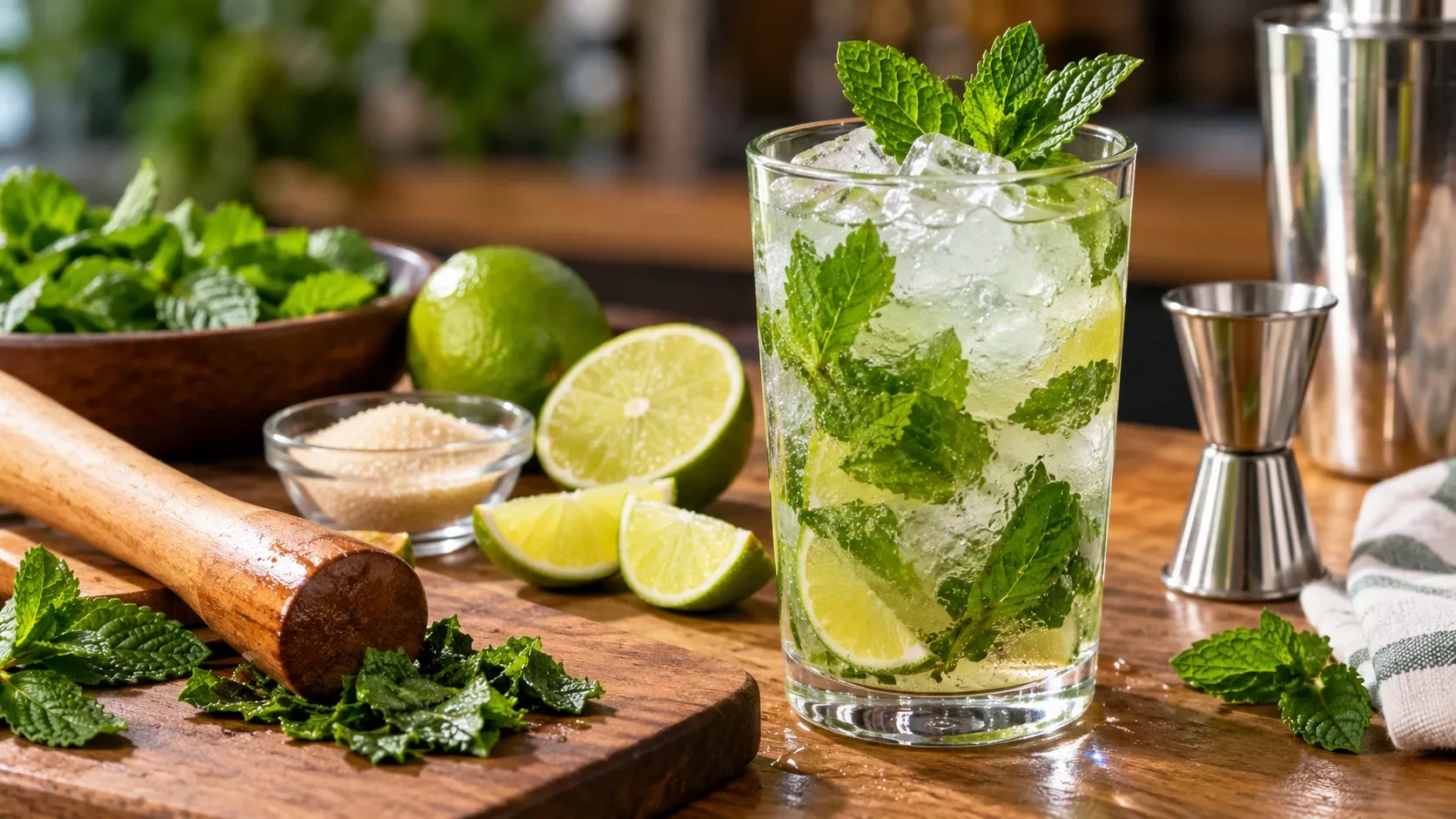
Short answer: for a balanced Mojito, you do not need to crush the mint until the leaves break apart. The International Bartenders Association (IBA) recipe tells you to mix the mint with sugar and lime juice; it does not require aggressive muddling. In bar practice, a light press can increase aroma release, but crushing and twisting the leaves too much also creates more fragments in the glass and may produce a greener or more bitter impression.
The best choice therefore depends on the result you want: a cleaner, fresher Mojito usually benefits from gentle mixing or light pressing; a glass with heavily muddled mint will have more intense extraction, but a rougher texture and less delicate finish. The key is to compare techniques while keeping the rest of the recipe unchanged.
What the IBA recipe actually asks for
The current IBA Mojito specification uses 45 ml white Cuban rum, 20 ml fresh lime juice, six mint sprigs, two teaspoons white cane sugar and soda water. The method instructs the bartender to mix mint, sugar and lime, add a splash of soda and ice, pour in the rum, top with soda and give the drink a light stir.
That matters because the IBA wording does not turn forceful muddling into a technical requirement of the classic. Some bars use a light muddle; others simply press or stir the mint with the other ingredients. An intermediate approach appears in Difford’s Guide, which recommends gently muddling only enough to bruise the leaves rather than pulverizing them.
Why stirring, pressing and crushing do not produce the same result
Mint aroma comes largely from volatile compounds in its essential oils. In plants of the genus Mentha, these compounds are produced and stored in specialized glandular structures on the plant surface. Reviews of Mentha chemistry describe glandular trichomes as important sites for the production and storage of aromatic compounds. Extraction studies also show that damaging these structures can release essential oil.
This helps explain what happens in the glass: some mechanical contact promotes aroma release. But more force does not mean endlessly better flavor. Tearing the leaf also creates particles, increases contact between other plant material and the liquid, and changes mouthfeel. Professional cocktail sources therefore commonly recommend moderate pressure and warn against turning mint into a paste.
It is better to treat any increase in bitterness as a bar-sensory tendency, not as an absolute chemical rule for every Mojito. The outcome depends on mint variety, leaf freshness, quantity, contact time, acidity, dilution and the drinker’s own perception.
Side-by-side test: three levels of mint handling
To notice the difference without confusing technique with recipe, prepare three glasses with the same ingredients in the same quantities, using similar ice and the same soda water. The only variable should be how the mint is handled.
| Level | Technique | What tends to change | Main risk |
|---|---|---|---|
| 1. Mix only | Combine mint, sugar and lime with a spoon, without deliberately pressing the leaves. | More delicate aroma, more intact leaves and a cleaner texture. | If the mint is weakly aromatic, the effect may seem subtle. |
| 2. Light press | Use two or three gentle presses with a smooth muddler or spoon, just enough to bruise a few leaves. | More obvious aroma, still with few fragments and a fresh profile. | It is easy to go too far if the tool has teeth or if you twist hard. |
| 3. Heavy muddle | Repeatedly press, crush and twist until several leaves are torn. | Fast extraction and strong initial aroma, but more particles and a greener sensation. | Rough texture, shredded leaves and a greater chance of a bitter or vegetal finish. |
How to run a fair test at home
- Use the same mint for all three glasses. Leaves from different sprigs can vary considerably in aroma. Divide visually similar portions.
- Keep the recipe fixed. You can use the IBA proportions in all three glasses. The purpose is not to choose the best recipe, but to compare handling methods.
- Control the ice. Quantity, size and preparation time affect dilution. Build the drinks in quick succession.
- Use the same amount of soda. More carbonation and more volume change aroma and acidity perception.
- Do not readjust sugar or lime afterward. If one glass seems more bitter, resist correcting it; that difference is part of the test.
- Taste blind if possible. Ask someone else to randomize the order. The sight of shredded leaves can influence expectations.
What to observe while tasting
Aroma before the first sip
Bring the glass to your nose without stirring it again. Compare how quickly the mint appears and whether the aroma seems fresh, sweet, minty or more “green.” A glass with more mechanical damage may release aroma faster, but that does not guarantee greater finesse.
Texture and leaf fragments
Notice how many pieces of mint float among the ice and reach your mouth. In a Mojito served without fine straining, this matters: a technique that produces a lot of debris can reduce drinking pleasure even if the aroma is intense.
Finish and bitterness
Compare the aftertaste after several sips, not just the first impression. A vegetal or bitter note may become clearer as the drink warms, dilutes and remains in contact with the leaves.
So which technique should you choose?
If the goal is a classic, refreshing and visually clean Mojito, starting with gentle mixing or light pressing is the safest choice. That approach is compatible with the IBA method and with professional bar guidance that calls for bruising rather than shredding the leaves.
Heavy muddling is not “forbidden,” but it changes the style of the drink. It can be acceptable if a bar deliberately wants more aggressive extraction and controls the fragments by another method, but it should not be treated as mandatory for extracting mint flavor.
Why the mint itself matters
“Mint” is not a completely uniform ingredient. Different Mentha species and cultivars have different aromatic profiles. In spearmint (Mentha spicata), for example, carvone is often a dominant essential-oil compound, while other mints can be richer in menthol and menthone. That helps explain why two bars can use the same technique and still produce different aromas.
For that reason, record which mint you use in the test and compare leaves with similar freshness. Poor technique can hurt a good herb, but weak raw material is not automatically fixed by applying more force with the muddler.
Practical rule
To keep the Mojito from becoming a glass full of shredded leaves, use the least force needed to reach the aroma you want. Mix first; if the mint seems too quiet, add a few gentle presses. Stop before most of the leaves tear. The goal is to release aroma without turning the mint into pulp.
Sources and references
- International Bartenders Association — Mojito
- Difford’s Guide — Mojito (Cuban-style)
- Plants of Genus Mentha: From Farm to Food Factory
- Feasibility study of repeated harvesting of menthol from biologically viable Mentha x piperita using ultrasonic extraction
- Bioactive properties of the aromatic molecules of spearmint essential oil: a review