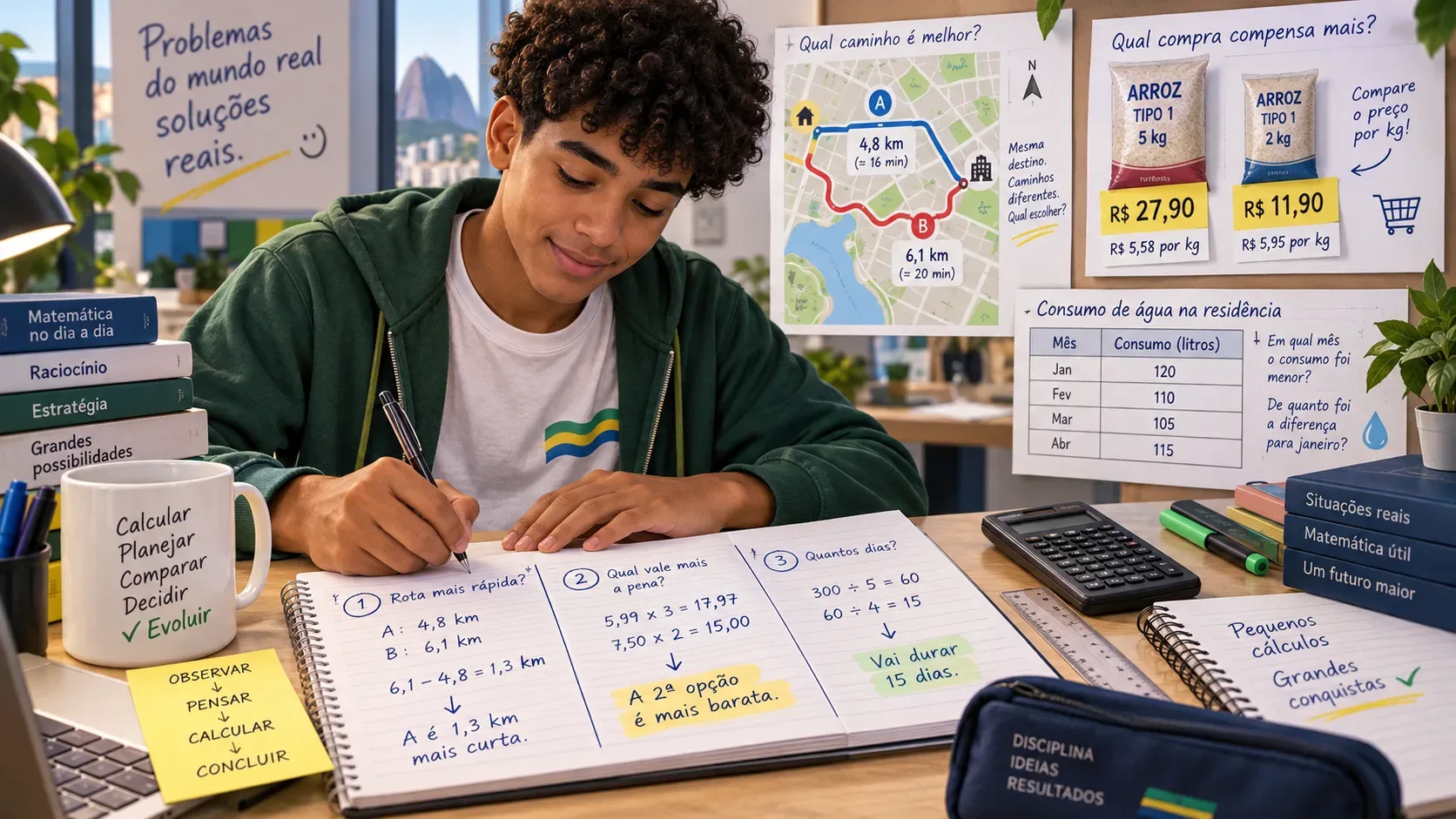
PISA Level 2 in mathematics does not mean mastering a closed list of topics. It indicates that a student can already recognize, in simple everyday situations, which mathematical representation to use and how to reach an answer that makes sense in context. In the PISA 2025 results released on 8 September 2026, the OECD reported that 28% of students in Brazil reached at least Level 2 in mathematics, compared with an OECD average of 65%. The country note gives examples such as comparing the total distance of two alternative routes and converting prices into another currency.
The three problems below are original teaching examples created to practice skills consistent with that description. They are not official PISA items and have not been psychometrically calibrated by the OECD; therefore, solving all three does not by itself establish that someone would officially be at Level 2.
What Level 2 requires in practice
Instead of looking for a hidden formula, the student needs to turn a simple situation into mathematics. This usually involves four moves:
- Select the relevant data: separate what will be used from what is only context.
- Choose an operation or representation: addition, subtraction, multiplication, division, unit rate, or another simple relationship.
- Carry out the calculation: work with the numbers correctly.
- Interpret the result: answer the question in the requested unit and meaning.
The OECD description published for Brazil emphasizes precisely the ability to recognize, without direct procedural instructions, how a simple situation can be represented mathematically. PISA organizes results into proficiency levels to give substantive meaning to the kinds of tasks students in different score ranges are likely to solve.
Problem 1 — compare two routes
Original teaching example, not an official item.
A person can travel from home to the library by two routes. Route A has three segments of 1.6 km, 2.3 km and 1.1 km. Route B has three segments of 2.4 km, 1.5 km and 0.8 km. Which route is shorter, and by how much?
Step 1: identify what must be compared
Comparing only one segment is not enough. The question asks for the total distance of each route, so the segments of A and B must be added.
Step 2: calculate Route A
1.6 + 2.3 + 1.1 = 5.0 km.
Step 3: calculate Route B
2.4 + 1.5 + 0.8 = 4.7 km.
Step 4: compare and interpret
5.0 − 4.7 = 0.3 km. Therefore, Route B is 0.3 km shorter.
What this practices: turning a map or route description into comparable sums and returning to the context to state which alternative is shorter. This is very close to one of the situations the OECD itself uses to illustrate Level 2.
Problem 2 — convert a price into another currency
Original teaching example, not an official item.
A book costs €18 at a foreign store, plus €4 shipping. For this exercise, use the hypothetical rate €1 = R$ 6.20 and ignore taxes or additional fees. The same book costs R$ 139.90 at a Brazilian store. Which option has the lower total price?
Step 1: add price and shipping in the original currency
€18 + €4 = €22.
Step 2: convert the total into Brazilian reais
€22 × R$ 6.20 = R$ 136.40.
Step 3: compare with the Brazilian price
R$ 139.90 − R$ 136.40 = R$ 3.50.
Step 4: answer in context
Under the stated conditions, the foreign purchase is R$ 3.50 cheaper. The key is not memorizing exchange rates, but recognizing that the euro total must be multiplied by the provided rate before making the comparison.
What this practices: identifying a conversion rate, applying it to the correct quantity, and interpreting the result. Converting prices into another currency is another example cited by the OECD when describing what students at Level 2 can do.
Problem 3 — compare unit prices
Original teaching example, not an official item.
Two rice packages have different sizes and prices. Package A contains 5 kg and costs R$ 27.90. Package B contains 2 kg and costs R$ 11.90. Which has the lower price per kilogram?
Step 1: recognize that total prices are not directly comparable
Package B costs less at checkout, but it also contains less rice. For a fair comparison, calculate the price for 1 kg.
Step 2: calculate Package A's price per kilogram
R$ 27.90 ÷ 5 = R$ 5.58 per kg.
Step 3: calculate Package B's price per kilogram
R$ 11.90 ÷ 2 = R$ 5.95 per kg.
Step 4: interpret the comparison
Because R$ 5.58 is lower than R$ 5.95, Package A has the lower price per kilogram, even though its total price is higher.
What this practices: choosing a simple representation — unit price — to compare two options that cannot be judged only by their total prices.
The pattern shared by all three problems
| Situation | Mathematical decision | Main calculation | Interpretation |
|---|---|---|---|
| Routes | Add the segments before comparing | Addition and subtraction | Which route is shorter |
| Currency | Convert everything into the same currency | Addition and multiplication | Which total price is lower |
| Packages | Turn prices into a unit price | Division and comparison | Which option costs less per kg |
In every case, the main challenge is deciding what to do with the data before calculating. That move from context to a simple mathematical representation is at the core of the type of reasoning highlighted by the OECD for Level 2.
How to study for this kind of task
- Before calculating, write one sentence stating what must be found.
- Mark the units: km, reais, euros, kilograms, minutes, or percentages.
- If there are two alternatives, put both in the same unit before comparing them.
- After the calculation, reread the question and answer with a complete sentence.
- Check whether the result is plausible: a route with smaller segments should have a smaller total; a price per kg should not be confused with the price of the whole package.
What Brazil's 28% means — and what it does not mean
The 28% figure is the share of assessed Brazilian students who reached at least Level 2 in mathematics in PISA 2025. It does not mean that 28% answered one specific question correctly, nor that Level 2 corresponds to a school grade or an ordinary test score. PISA uses a proficiency scale built from the full set of responses and item difficulties.
These exercises are therefore tools for guided practice, not an official diagnostic. The intended gain is learning to recognize reasoning patterns: compare totals, standardize units, apply a rate, and interpret what the resulting number means in the situation.