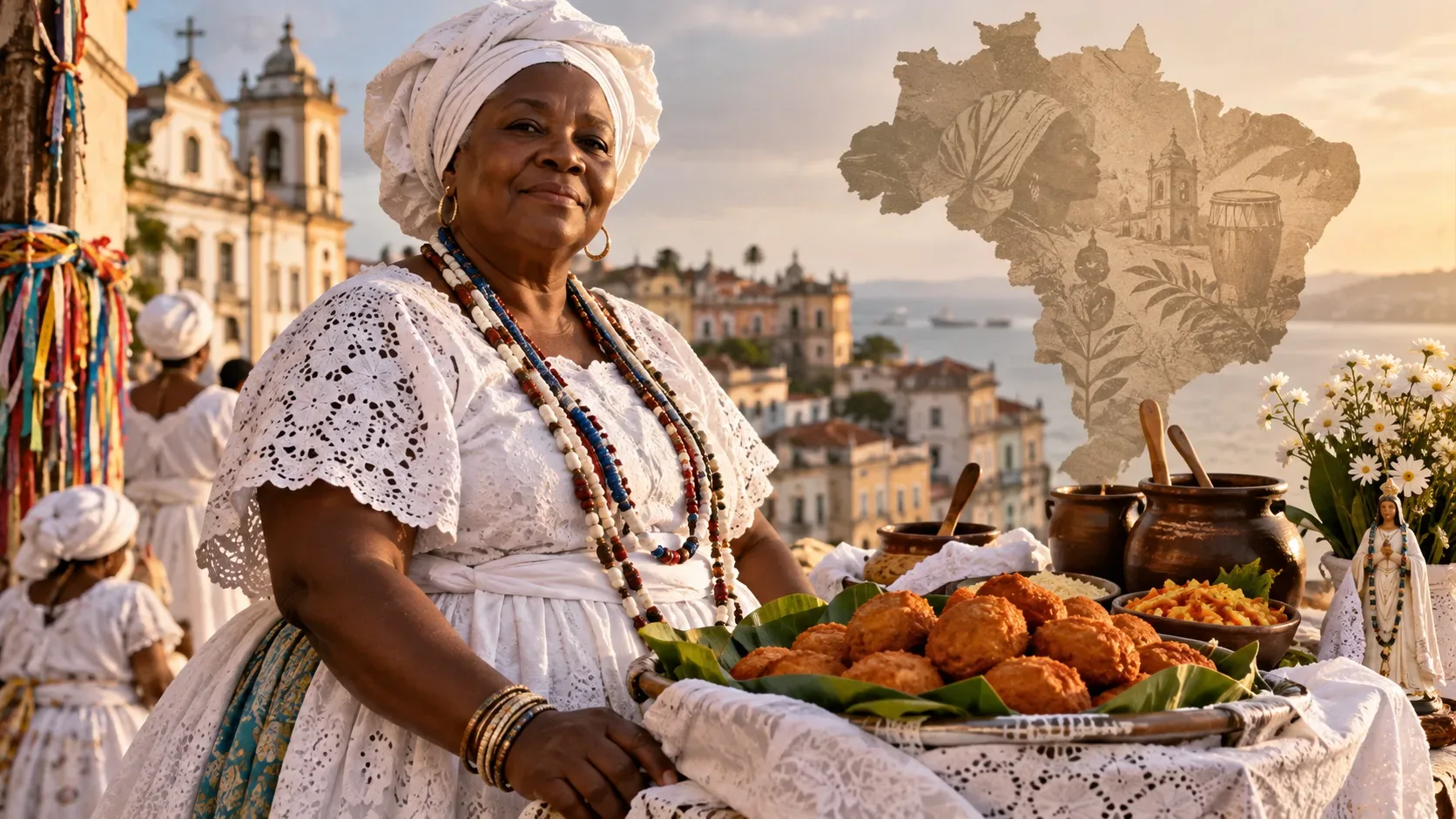
The Craft of the Baianas de Acarajé protects more than a food. Iphan's registration recognizes a living set of knowledge and practices: ways of preparing and serving traditional baiana foods, historical relationships with Afro-Brazilian religions, clothing, organization of the street-vending tray, forms of work, and transmission of knowledge across generations. On December 7, 2022, the title was revalidated and its territorial scope became national, covering Brazilian states where the cultural practice has been or may be identified.
What exactly is registered as heritage
The cultural asset entered in the Book of Knowledge is the Craft of the Baianas de Acarajé. That distinction changes the focus: the heritage is not only the fritter fried in palm oil, but the social practice that brings together knowledge, techniques, religious references, ways of dressing, labor relations, and a public presence in streets and squares.
Brazil's Ministry of Culture describes this universe as a set of practices involving food preparation, religiosity, clothing, and sales from the traditional tray. Iphan likewise treats the craft as a practice transmitted and recreated by its bearers and connected to Afro-Brazilian memory and identity.
| Dimension of the craft | What it includes | Why it matters to the registration |
|---|---|---|
| Culinary knowledge | Selection and preparation of ingredients, use of palm oil, acarajé, abará, and other foods sold from the tray. | These are traditional forms of knowledge transmitted through practice, not merely an isolated recipe. |
| Religiosity | Historical relationships with Afro-Brazilian religions and ritual meanings associated with acarajé. | It places the food within a broader cultural universe without assuming that every baiana has the same religious affiliation. |
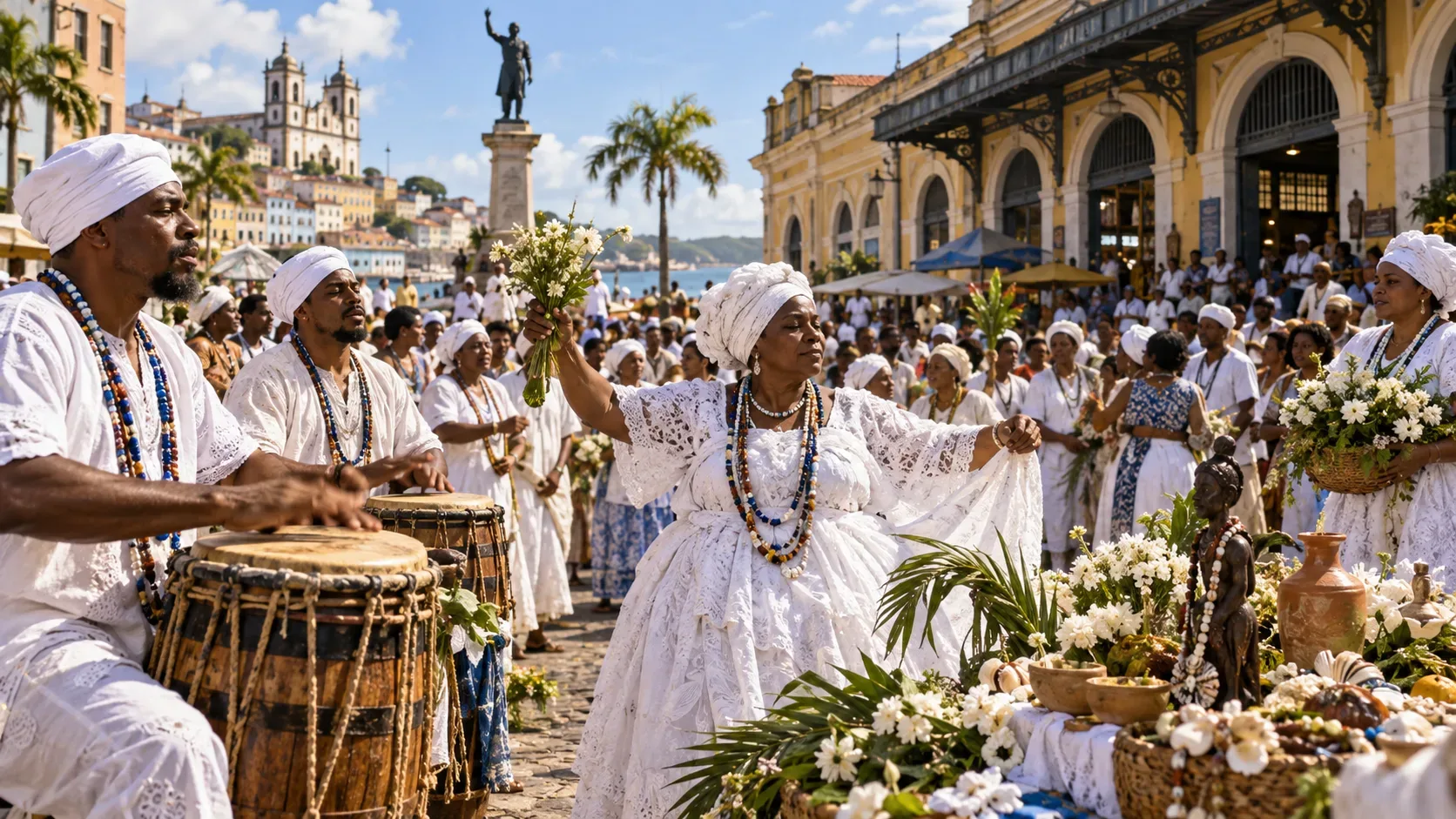
| Traditional clothing | Garments such as full skirts, lace, headwraps, and necklaces, with their own variations and meanings. | Dress is part of the craft's cultural expression and public presence. |
| Tray and work | Organization of the sales point, presentation of foods, service, and occupation of streets, squares, markets, and festivals. | The heritage includes the social and economic dimension of the activity performed by its bearers. |
| Transmission | Learning within families or from more experienced baianas. | The continuity of the heritage depends on people who practice, teach, and update this knowledge. |
Why acarajé alone does not summarize the heritage
Acarajé is the most visible element on the tray, but reducing the registration to food erases an essential part of its history. According to the Ministry of Culture, the preparation has origins connected to the Gulf of Benin in West Africa, and the related knowledge reached Brazil with enslaved Africans and was preserved over time mainly by Black women. In Candomblé, the food is linked to the orixás Xangô and Oyá and may involve specific knowledge and practices.
At the same time, the registration does not turn every sale of acarajé into a religious act, nor does it require every practitioner to share a single personal history. What it recognizes is a traditional cultural universe in which cuisine, ancestry, work, religiosity, clothing, and sociability intersect.
What changed on December 7, 2022
At the 102nd Ordinary Meeting of the Cultural Heritage Advisory Council, Iphan approved the revalidation of the Cultural Heritage of Brazil title for the Craft of the Baianas de Acarajé and changed its territorial delimitation. Its scope became the entire national territory, in the federative units where the cultural practice has already been or may come to be identified.
The official reasoning was that the area previously considered no longer reflected the craft's actual presence. The re-evaluation pointed to its dispersion across much of the country, and the change also responded to a request presented by representatives of the baianas themselves. The expansion therefore was not an abstract declaration that acarajé is “national”; it was an update to the registration so that it would reflect where the craft is actually practiced.
What “national scope” means — and what it does not mean
Iphan's wording matters because it combines national reach with concrete identification of the practice. The registration can recognize the craft in different Brazilian states without erasing its historical roots or requiring it to appear in exactly the same way everywhere.
- It is not a standardized recipe. Intangible heritage is living and can include variation as long as the cultural references of the heritage remain recognizable to its bearers.
- It does not remove Salvador and Bahia from the craft's history. The wider scope recognizes the movement and presence of baianas in other states.
- It does not automatically turn every acarajé business into the registered heritage. The object of safeguarding is the craft as an identified cultural practice, with its knowledge, references, and modes of transmission.
- It broadens the horizon for safeguarding. Documentation, recognition, coordination, and support actions can consider bearers and contexts beyond the previous territorial scope.
Why the bearers are central to protection
In intangible-heritage policy, safeguarding depends on the participation of the people and groups who keep the heritage alive. Iphan explains that safeguarding plans and actions should be built through social mobilization and participation by the bearers. In revalidation, one of the criteria is precisely whether the heritage remains a cultural reference and whether its practitioners consent to continued recognition.
This helps explain why the registration cannot be read as a simple government seal placed on a dish. The baianas are agents of the heritage: they practice it, transmit it, adapt it, organize collectively, and identify risks to its continuity, including religious intolerance, insecurity in the use of public space, or commercial appropriations that may empty out traditional references.
Registration is different from listing a material monument
The Craft of the Baianas de Acarajé is an intangible cultural asset registered in the Book of Knowledge. Brazil's “tombamento” system is chiefly associated with the protection of material assets such as buildings, urban ensembles, and objects. For practices, knowledge, and ways of making, the instrument is Registration, accompanied by safeguarding policies.
This difference matters because intangible heritage is not preserved by freezing it in time. It continues to exist through the people who practice it. Safeguarding seeks to support conditions for continuity, transmission, and recognition while respecting transformations compatible with the cultural reference that has been recognized.
How to read the registration today
To understand the recognition without reducing it to gastronomy, three official sources are particularly useful: the Iphan page for the registered cultural asset, Iphan's report on the 2022 revalidation, and the Ministry of Culture feature published on September 15, 2026.
Taken together, they show the essential point: the heritage is the craft. Acarajé is a central part of it, but the recognition extends to the women, knowledge, ways of making, clothing, tray, relationships with religiosity, and forms of transmission that keep the tradition alive. The 2022 national expansion adjusted the institutional map to a practice that had already moved beyond the earlier territorial scope.