
Calculating family income for Brazil's Benefício de Prestação Continuada, known as BPC, requires more than adding up the money received by everyone who lives at the same address. The rules use a specific family group defined for the benefit and also determine which income is included, which amounts are disregarded, and which ongoing expenses may be deducted in the situations allowed by the rules.
In 2026, Brazil's national minimum wage is R$ 1,621.00. One quarter of the minimum wage is therefore R$ 405.25 per person. The BPC income test uses monthly family income per person equal to or below that threshold, while all other eligibility requirements still apply. The 2026 minimum wage was established by Decree No. 12,797/2025.
The calculation starts with the BPC family group, not with every resident
The first question is not how much the household receives, but who belongs to the legal family group used for BPC. According to guidance from Brazil's Ministry of Development and Social Assistance, the group includes the following people when they live under the same roof:
- the BPC applicant;
- the applicant's spouse or partner;
- the parents and, when they are absent, a stepmother or stepfather;
- unmarried siblings;
- unmarried children and stepchildren;
- minors under guardianship.
This concept is narrower than the everyday idea of a family or household. Grandparents, aunts and uncles, cousins, friends, married siblings, and married children do not become part of the BPC family group solely because they live at the same address. If someone is not part of the legal group, that person is also not included in the number used to divide the family income.
The MDS official page on calculating income per person stresses that not everyone living in the same home is considered family for BPC purposes.
How to calculate income per person in 2026
After defining who belongs to the family group, the basic calculation has two steps:
- add the monthly income that must be counted for the members of that group;
- divide the total by the number of people in the BPC family group.
In simple terms: income per person = countable family income ÷ number of people in the family group.
In 2026, the result is compared with R$ 405.25, one quarter of the R$ 1,621.00 minimum wage. This benchmark must be updated whenever the minimum wage changes.
Which income is counted
The rule starts from the total monthly income received by members of the family group. In practice, amounts are counted unless the law or applicable regulations expressly exclude them.
Relevant examples include wages, income from informal work reported in the Cadastro Único, benefits and other income not included in the exclusion list and, under the current rule, Bolsa Família. MDS guidance also says the applicant must report in CadÚnico benefits from Social Security or federal, state, or municipal systems, including unemployment insurance.
An important 2026 change concerns Bolsa Família. In September 2026, MDS stated that after Law No. 15,077/2024, Bolsa Família payments began to count as income when BPC is assessed. A family may continue receiving Bolsa Família while INSS reviews the BPC application, but the program amount is included in the income test. The current procedure is explained in the MDS page Beneficiários do Bolsa Família podem solicitar o BPC sem cancelar o programa.
Which amounts are not included in BPC family income
Current regulations list income that must be disregarded. This includes:
- supervised internship scholarships;
- income from apprenticeship contracts;
- temporary financial assistance or compensation for damage arising from dam failures and collapses;
- another BPC paid to an older person or a person with a disability in the same family group;
- a social security benefit of up to one minimum wage granted to a person with a disability or to a person older than 65, subject to the applicable rules;
- the inclusion allowance and the earnings of the person receiving that allowance in the situations covered by the rule for maintaining another family member's BPC.
If one family member receives more than one social security benefit of up to one minimum wage that fits the exclusion rule, MDS guidance states that only one of them may be disregarded in the calculation. The current list appears on the official MDS BPC page and in the consolidated regulation under Decree No. 6,214/2007.
Deductible health expenses are not the same as excluded income
There is an important difference between not counting a certain type of income and deducting an expense. Joint MDS and INSS guidance allows ongoing and documented spending on health treatment, medicines, diapers, and special foods to be deducted from family income when those items are not provided free of charge by SUS, or when the required service is not offered by SUAS.
These deductions depend on evidence and on the review of the case. Families should not simply subtract any household or health expense from their income. The required documentation must be submitted and the situation reported in the application. MDS summarized this rule in its 2025 update, revised in 2026, on BPC rules and income assessment.
Examples of different households
| Situation | Who belongs to the BPC family group | Countable income | Income per person |
|---|---|---|---|
| A 67-year-old applicant lives with his wife and a married son who earns a salary. | The applicant and his wife. The married son does not enter the group solely because he lives in the home. | If the couple has no countable income, the married son's salary is outside the calculation because he is not part of the BPC family group. | R$ 0.00 ÷ 2 = R$ 0.00. |
| A person with a disability lives with the mother, an unmarried brother, and a grandmother. The mother earns R$ 900.00 and the brother has R$ 600.00 in informal income. | The applicant, the mother, and the unmarried brother. The grandmother is not part of the BPC legal family group. | R$ 1,500.00. | R$ 1,500.00 ÷ 3 = R$ 500.00. In 2026, this is above R$ 405.25. |
| A 66-year-old applicant lives with his 68-year-old wife, who receives a retirement benefit equal to one minimum wage, and an unmarried daughter with no income. | The applicant, the wife, and the unmarried daughter. | The wife's social security benefit of up to one minimum wage may be disregarded under the specific rule for older beneficiaries. | If there is no other countable income, R$ 0.00 ÷ 3 = R$ 0.00. |
| A person with a disability lives with the mother, who earns R$ 900.00, and an unmarried brother under an apprenticeship contract who receives R$ 700.00. The family also receives R$ 300.00 from Bolsa Família. | The applicant, the mother, and the unmarried brother. | R$ 900.00 in wages + R$ 300.00 from Bolsa Família. Apprenticeship income is disregarded. | R$ 1,200.00 ÷ 3 = R$ 400.00. In 2026, this is within the R$ 405.25 limit. |
| A person with a disability lives with the mother, who earns R$ 1,500.00, and an unmarried brother with no income. There is R$ 400.00 per month in ongoing health expenses that qualify for a deduction and have been documented. | The applicant, the mother, and the unmarried brother. | R$ 1,500.00 minus an accepted R$ 400.00 deduction = R$ 1,100.00. | R$ 1,100.00 ÷ 3 = R$ 366.67. |
These examples illustrate the method. A real decision depends on CadÚnico data, official databases checked by INSS, the evidence submitted, and all other BPC requirements.
Residence, the BPC family group and Cadastro Único are related but not identical concepts
Three different questions are often confused: who lives at the address, who appears as family in CadÚnico, and who is part of the family group used for the BPC income calculation. CadÚnico has its own household composition rules, while BPC applies a specific legal list for the per-person income test.
For that reason, simply copying the number of residents in the home is not enough. First identify the relationships and marital status that matter under BPC rules. Then verify which income belongs to the people who actually form the BPC family group.
Common mistakes that change the result
- dividing income by the total number of residents even when some of them are not part of the BPC family group;
- ignoring informal income earned by a person who is part of the group;
- disregarding Bolsa Família based on older guidance even though MDS stated in 2026 that it is included;
- counting another family member's BPC as income when the rules require it to be disregarded;
- excluding any one-minimum-wage retirement benefit without checking the recipient's age or disability status;
- deducting health expenses without the required evidence or outside the accepted situations;
- using an outdated minimum wage to set the one-quarter threshold.
Checklist before an application or review
- List everyone who lives in the home.
- Mark which people belong to the legal BPC family group.
- Record the monthly income of each member of that group.
- Separate the income that the rules require to be disregarded.
- Check whether there are ongoing health deductions that can be documented.
- Add only the income that must actually be counted.
- Divide by the number of people in the BPC family group.
- Compare the result with the current threshold. In 2026, R$ 405.25.
- Check that CadÚnico is up to date and that address, family composition, and income information are correct.
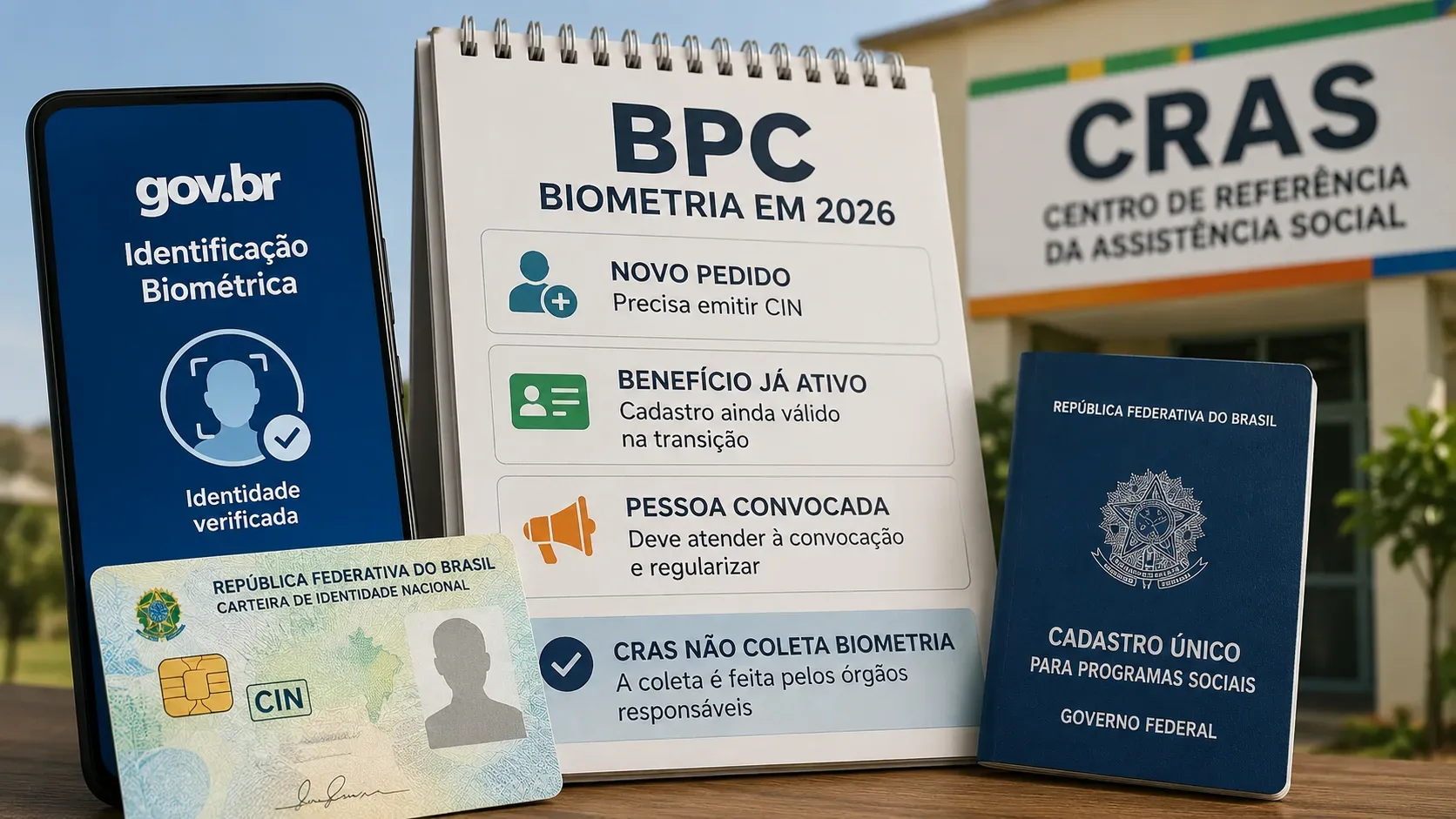
MDS recommends updating CadÚnico whenever the address or family composition changes. Registration and updated records are also operational requirements for BPC. If there is uncertainty about who belongs to the family group or which documents support a deduction, the local CRAS can provide guidance, while INSS is responsible for deciding the application.
In summary
To calculate BPC family income correctly, separate the process into three stages: first, define the legal family group; second, identify which income is included and which amounts are disregarded; finally, apply permitted and documented deductions before dividing the income by the number of family members. In 2026, one quarter of the minimum wage is R$ 405.25 per person. The income calculation is one eligibility criterion and does not replace the assessment of the other BPC requirements.